- Full Brim Safety
- Posts
- The Near-Miss Audit


The Near-Miss Audit
Welcome back, let's Build Smart & Build Safe! We’ve looked at our OSHA logs and identified injury trends. Today, we address the most valuable data your company (hopefully) collected in 2025: The Near-Miss Reports.
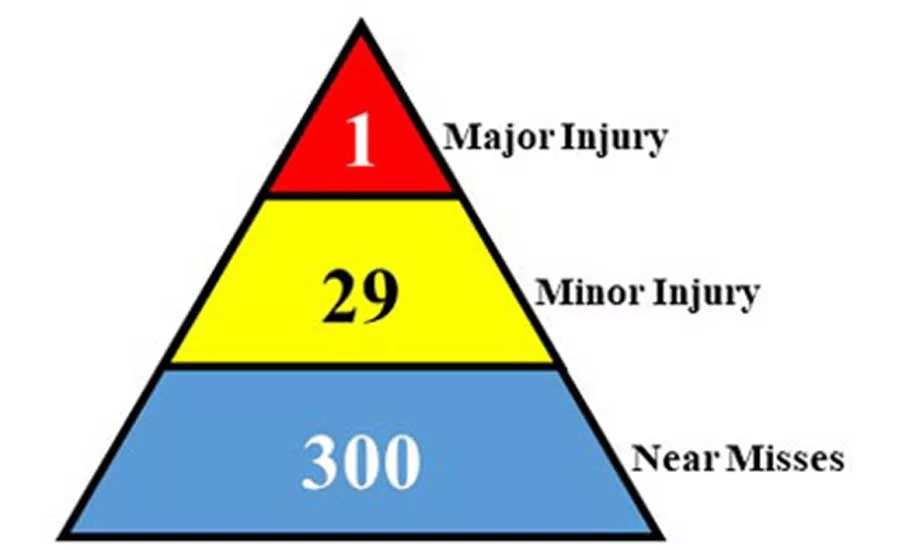
You may have hear of the "Safety Triangle." It suggests that for every one serious injury, there are dozens of minor accidents and hundreds of near misses. If you only focus on the injuries that actually happened, you are ignoring 90% of the warning signs that were sent your way this year.
The "Free Lesson" Principle
A near miss is a "free lesson." It’s an incident where the sequence of events was exactly the same as a disaster, but the final outcome was different because of luck or a split-second reaction.
Intellectual Honesty: If your 2025 near-miss log is empty or very short, be skeptical. It is statistically impossible for a year of construction to pass without hundreds of close calls. An empty log usually indicates a "fear culture" where workers don't want to look "stupid" or get in trouble for a mistake that didn't end in an injury.
The Audit: Look at the near misses you did capture. Do they mirror the injuries in your OSHA log? If your injuries are mostly hand cuts, but your near misses are all about heavy equipment, you have a blind spot in your reporting system.
How to Audit Your 2025 Near Misses
To make this data useful for 2026, ask three "Skeptical Questions" of your 2025 reports:
Was the Root Cause Found? Did we just say "the worker slipped," or did we realize the floor coating becomes ice-slick when it gets humid?
Did We Actually Change Anything? Look at a report from March. Is the hazard still there today? If we didn't fix the problem, the near miss was a wasted opportunity.
Are the Reports Detailed? "Almost hit by a car" is a bad report. "Delivery truck backed up without a spotter near the main gate at 7:00 AM" is a data point we can use to change our 2026 delivery protocols.
The "Close Call" Goal for 2026
The goal isn't to have fewer near-miss reports; it's to have better ones. A high volume of near-miss reporting is a sign of a healthy, transparent culture. It means your crew trusts you enough to say, "Hey, I almost messed up, and we should fix this before the next person does."
Tomorrow, we’ll discuss "Closing the Loop"—ensuring that the hazards we identified this year were actually eliminated, not just moved around.
Please share us with your friends for a daily dose of construction safety tips!
-The Safety Man